What did women have when they gathered at the birth bed, the waulking table and the wake, that so many of us are missing now? A walk through some of the rooms where women once held each other, and an online women's circle open to founding members.
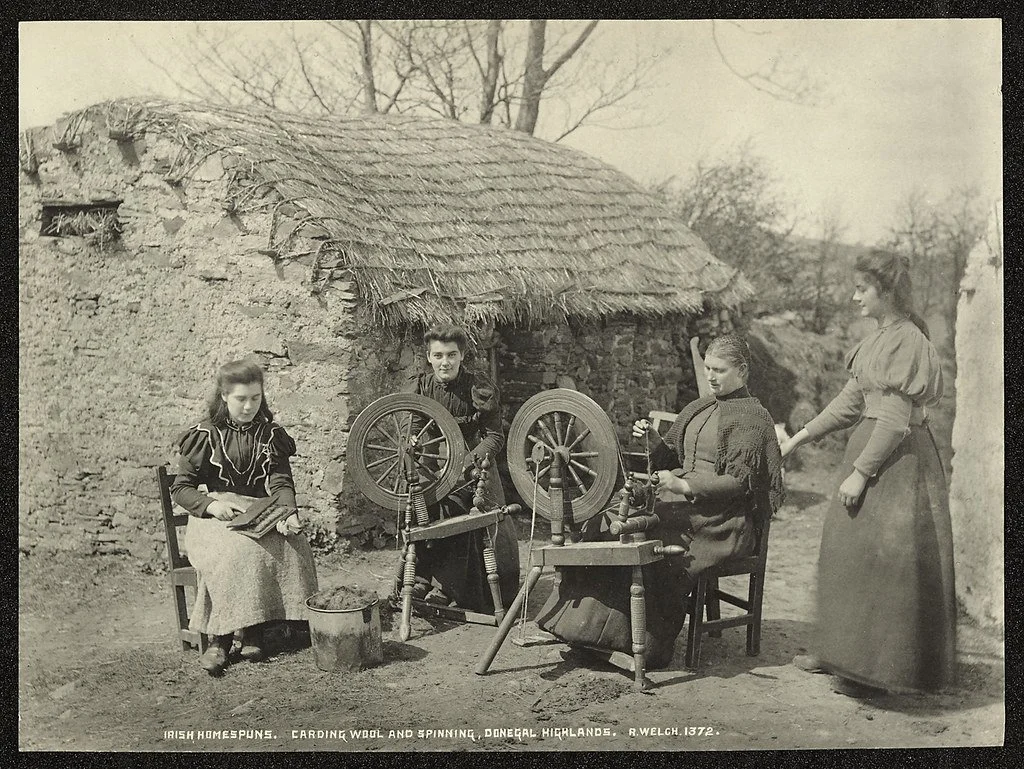
Carding wool and spinning, County Donegal, 1914. Photograph by R. Welch. Public Record Office of Northern Ireland
Waulking songs: listening to the women of Barra
There is a recording I keep going back to.
Barra, 1965. A length of wet tweed lies along a board, and a row of women sit on either side of it.
One woman lifts a line. The others answer with sounds that are not quite words. Then the thump. Cloth on wood, all their hands at once, and the song moves on.
They started slow, because wet wool is heavy. As the cloth dried, the songs got faster. By the evening the verses were full of teasing. Who was courting whom. Whose man had been seen where. And sometimes the women around the table were sung into the verses themselves, each one named in turn.
I didn't grow up with waulking songs. But I grew up with women who worked like this. Nobody in my nana's house did a hard job alone. Whatever needed doing, the women came, and did it together.
Women of every age at one table, hands busy, and none of them on their own.
Sitting here at my desk in Bristol, I feel the ache of how things have changed.
Those women's lives were not easy at all, and I wouldn't wish all that hard work and lack of human rights back on anyone.
What I miss is what they had in the middle of it. Each other.
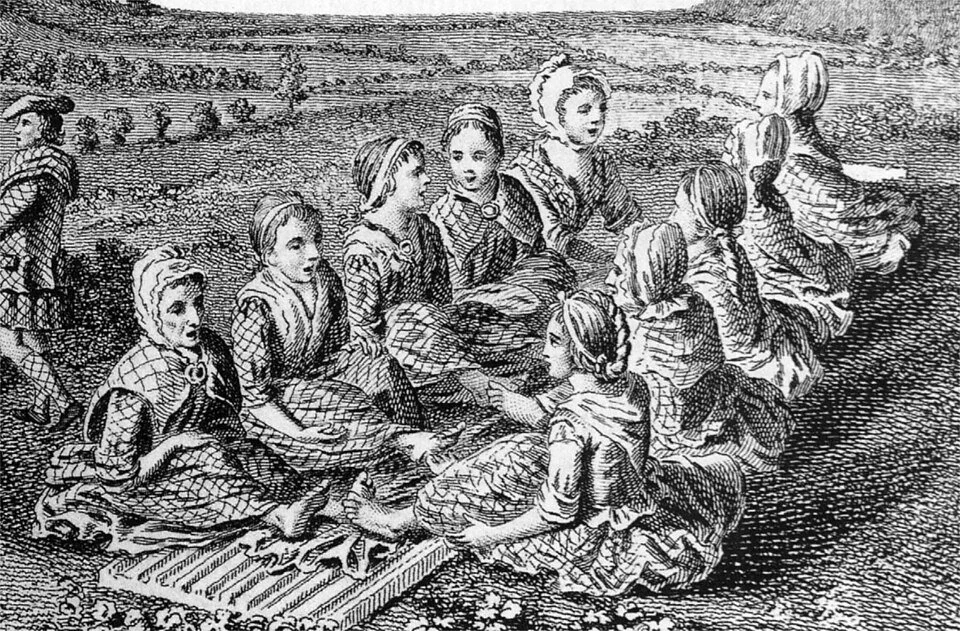
Women waulking cloth in Scotland, c. 1770. Engraving, public domain.
Growing up among women in my nana's kitchen
It smelt of lemons and blackcurrants. Of meringue, and pavlova, and crumble.
There were always women in it. Women baking. Women shelling beans into a bowl. Women knitting and sewing, the needles clicking under the talk. Older women, mothers, aunties, girls, and me, the smallest, in the middle of it all.
My earliest memory is picking blackcurrants with her. I was two, maybe three, not yet at school. I remember the jam in the pot, dark and bubbling, and thinking that pot was big enough for me to fit in.
I loved it. I loved being with all of them, every age at once.
Nobody called it anything. It was just what women did.
Perhaps you had a kitchen like that. An aunt's, a neighbour's, a grandmother's. Somewhere you could sit among the women and simply be.
Or perhaps you didn't, yet you may have sensed the ache of something missing without quite knowing its shape.
Women across Ireland, Scotland, Wales and England gathered in rooms like these for centuries. I've been following them back through the archives, and I'd love to take you into a few of them with me.
The original meaning of gossip: the women at the birth bed
When a medieval woman went into labour, she sent for her gossips.
The word comes from the Old English godsibb, a godparent, kin in God. By the 1300s it meant something closer. The women friends you called to your bed when the baby was coming. Not only the midwife. Your women. The ones who would stay.
They had a life together beyond the birth room, too. The mystery plays mocked wives who slipped off to the tavern with their gossips to drink and laugh. In the Chester play, Noah's wife will not set foot on the ark unless her gossips come with her.
Then the word turned.
Over the centuries that followed, gossip came to mean idle talk. Women's talk. Petty, spiteful, not to be trusted. And in some towns a woman who spoke out of turn could be locked into an iron cage on her head, with a metal plate pressed down on her tongue. It was called the scold's bridle. Some called it the gossip's bridle.
How did the word for the women at your bedside come to mean women who talk too much? And how many of us, when we finally do talk about what our bodies are going through, worry that we're saying too much?
I think of the women I sit with who heard hard news about their bodies alone. Myself included. Ten minutes with a consultant. Then the car park, and the drive home on their own. No one sent for their gossips.
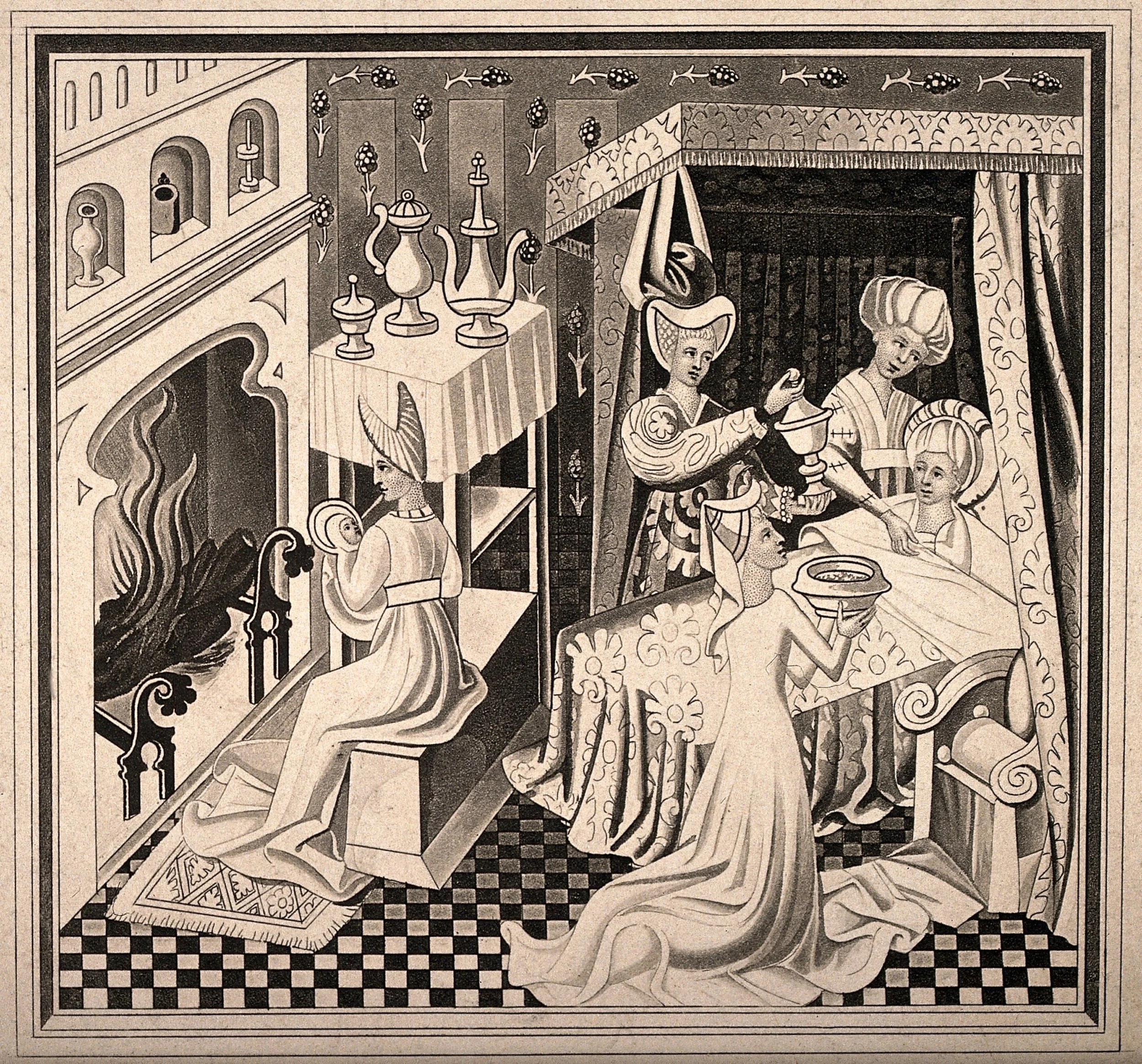
The birth of St Edmund, after the miniature in John Lydgate's Lives of Saints Edmund and Fremund (England, 1434–1439). Aquatint by Henry Shaw, 1843. Wellcome Collection.
Women's work songs: side by side at the waulking table
Back to Barra.
Waulking was the last stage of making tweed by hand. The cloth was soaked, then beaten against the board for hours until it shrank and thickened. Hard, heavy work, and in Scotland only women did it.
What stays with me is how they sat. Side by side, not face to face. Eyes on the cloth.
No one had to look anyone in the eye, or explain how she was, or be anything at all. The rhythm held the room, and the song carried whatever needed carrying. Grief. Longing. A bit of scandal. A lot of laughing.
And between the songs, there was the talk. Whose husband was drinking again. Whose daughter was struggling with the new baby. Who needed a hand at the harvest, or a bit of money, or just a visit. The troubles of the township were talked over at that table, and very often, between them, the women sorted them out.
Perhaps, with the hands busy, the heart had room to do what it needed.
It was the same thing I loved in my nana's kitchen. The beans and the needles. Women together, talking sideways, over the work.
By the 1950s the mills had taken the waulking over. The cloth still gets finished, but the women no longer gather around it.
And with the table went the talk. Troubles that a dozen women once worked through together over the cloth are now carried by each woman on her own.
“I don’t want to look back through rose-tinted glasses. It was gruelling work, the cloth often soaked in stale urine, done by women with little money and less choice, and their hands were raw by the end of it. None of us would want that life back. But something went with it. Troubles that a dozen women once worked through together over the cloth are now carried by each woman on her own.”
Think of the last time you had to talk about something hard. Most likely across a desk, eyes on you, or on a video call with your own face looking back at you. Is it any wonder the words don't always come?
The waulking women never had to sit facing each other and find the words first. They came to do the work, side by side, and the talk found its own way in.
I've tried to make room for that in the online membership. No one is asked to speak. You can come with your knitting or a cup of tea, listen for as long as you like, and let the words come when they're ready.
Keening at the Irish wake: crying your own dead
In a wake house in the west of Ireland, a hundred years ago, the village women have washed the body and laid it out on the bed, candles lit around it. Every man who comes in is handed a clay pipe of tobacco, and a plate of snuff goes round the women. Later there will be songs and stories and games, grief and life in the same house, as I've written about before.
Then a woman goes to the bedside and begins to keen. Her voice rises and falls. She rocks, and claps her hands. Other voices join the cry.
The sean-nós singer Joe Heaney, from Carna in Connemara, heard the keening women often enough himself. In a recording made years later, he remembers that they didn't have to be related to the dead, and they weren't paid. They were simply known for it, and given great respect. By the end, he says, everyone in the house was in tears. The men, the women and the children.
And he says something I can't stop thinking about. The keening woman was crying her own dead.
Standing by a neighbour's body, raising the caoineadh, she was perhaps also lamenting her own mother, her own child, her own lost years. The wake gave her somewhere to put them. Out loud, in front of everyone, with women around her.
The Catholic Church fought it. Synod after synod, from the 1600s into the 1800s, condemned the keening women, and some recommended excommunication. Keening held on in places into the last century. Then it was banned by the church in 1955.
Now grief comes with a few days' compassionate leave, and then back to work. There is rarely a room where you can bring your own losses into a shared lament, the way the keening women did.
And some losses never get a wake at all. The body you had. The life you thought you would live.
But I think the keening women knew something we can still carry with us. Perhaps grief never needed a coffin. Only somewhere to go, and other women to hear it.
Your losses deserve to be witnessed too.
I wanted the online membership to have a place for those losses. In The Hearth, you can put them into words on any day of the week, and other women will hear you. There's no advice and no fixing. Only women keeping you company in it.
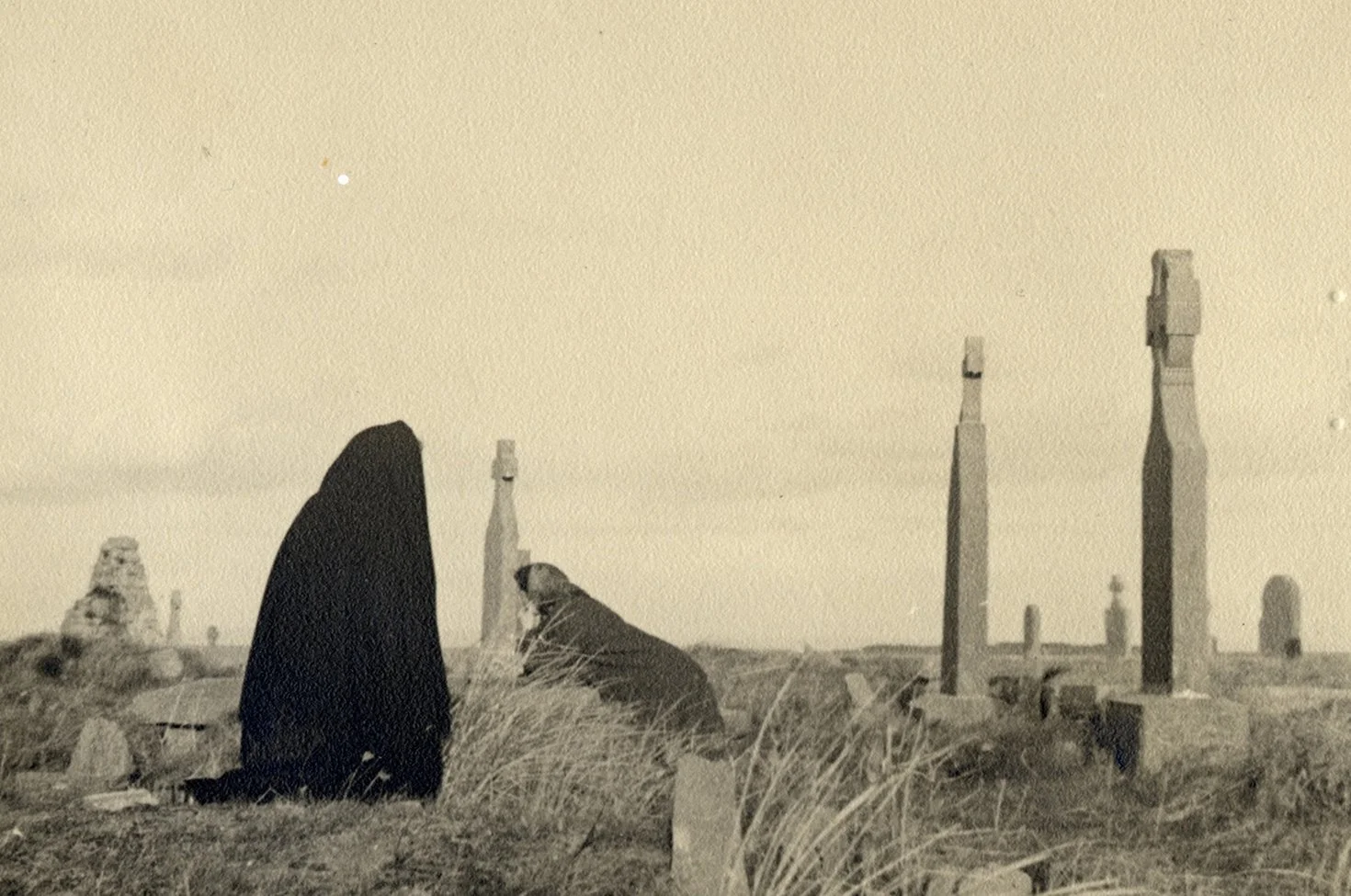
Funeral on Inis Mór, 1940. Photograph by Heinrich Becker. © National Folklore Collection, University College Dublin.
Welsh knitting nights and the Irish open door
On a winter's night in the 1770s, a traveller passing through Bala, in north Wales, noticed the women going to one another's houses to knit together by the fire. They went, he wrote, "through love of society", and while the needles moved, someone would tell an old tale, or sing an old song, or play the harp. They called it cymorth gwau, the knitting assembly.
Through love of society. I find myself smiling every time I read that. There was no job that had to be finished, and no crisis to tend. They simply enjoyed each other's company, and so they went.
In Ireland it was the airneán, the night visiting. Some houses were known for it. The fire was in, the kettle was on, and the door was open to whoever came.
Where I grew up, in the north west of Ireland, that was still how it was. You didn't wait for an invitation. You called in, or someone called in to you, and there was always room and lots of food at the table!
Life is so different now. More often than not, the door is a booking page. Pay in advance, pick your date, and hope your body agrees.
And if your body keeps its own calendar, you may know how that goes. You book. You have a bad week. You send the text, so sorry, not up to it. And after a while, perhaps, you stop booking at all.
I love that the fireside never asked that of anyone. You came when you could, and the company of women was there when you needed it.
It's that company I've been making room for in the membership. Not one fixed night you have to be well for, but women around the fire, whenever you're ready to come in.

Newtown Women's Institute knitting comforts for the troops, 25 November 1939. Photograph by Geoff Charles. National Library of Wales.
Nollaig na mBan: the Irish Women's Christmas
And once a year, in parts of Ireland, the women took the day off.
Nollaig na mBan, Women's Christmas, falls on the sixth of January. After weeks of cooking and cleaning, the women went visiting. They sat in each other's houses with tea and the last of the Christmas cake. In some homes, the men served them.
In Cork, women still remember shawled women hurrying to the pub that night and filling the snug. For the rest of the year, a respectable woman did not drink in a pub. For one night, they took it over without shame.
One day of rest, given to tired women. I find myself thinking of all the women who waited the whole year for it. And of how many of us still rest as if we need permission.
There is something here I keep coming back to.
“Some of these rooms were closed by machines, and some by time.
But not all of them. A word for women’s friendship became an insult, and then an iron cage.
Keening was condemned from the pulpit. I can’t help noticing how often women gathering, talking and grieving out loud together was treated as something to be managed.
What did they see in us, together, that needed managing?
Perhaps the same thing I see in circle now. Women together, remembering they were never too much.”
Why women still need to gather
What I have seen, again and again, in circle is that when women gather, something shifts.
We are believed, sometimes for the first time in a long while. A woman says out loud what her body has been doing, or what she has been carrying on her own, and around the circle other women nod, because they know. You can see something in her settle. It was never just her. And once we know that, it becomes much harder for anyone to keep us small.
That moment matters, because so many of us have learned to be the one who is always fine. Fine at work, fine on the phone, fine in the consulting room, explaining our bodies one more time and hoping that, this time, we'll be believed. It isn't only us.
When women in England were asked about their health care in 2021, 84% said there had been times they were not listened to. The government's own strategy admitted the system had been "designed by men, for men".
And for those of us whose bodies keep their own calendar, there are weeks when getting dressed is the whole day, and the world draws in to the walls around us, and the invitations slowly stop coming.
It's no wonder that people living with a long-term health condition are almost three times more likely to be women.
There are many reasons so many of us end up carrying so much alone. But I think losing the rooms where women held each other is one of them, and one we rarely name.
“Perhaps women who believe each other have always been harder to manage than women alone.”
And I can't help noticing that whenever women have built those rooms, someone has tried to make them small.
A word for women's friendship became an insult, and then an iron cage. Keening was condemned from the pulipt.
And it still happens. When women get together and talk about what is going on in our bodies and our lives, it so often gets called a moan, or a natter, or a bit of girls' chat. Many of us have learned to say it ourselves, half apologising before we start. Sorry, I'm just having a moan.
Gossip. A moan. A natter. Women's talk. The words change, but the pattern is an old one. Perhaps women who believe each other have always been harder to manage than women alone. So when I watch a woman in circle look up and see the others nodding, I think of the gossips at the bedside. The same thing is happening. She is being believed.
I can't rebuild my nana's kitchen.
But perhaps I can build a room with the same ethos.
An online circle for women on healing journeys
I've shaped this space to hold both of the old ways women gathered. The occasions: a live circle every month, and ceremony as the Celtic year turns. Things to plan towards and come together for.
And the fireside. The Hearth is where women share what they are carrying, in their own words, on any day of the week. The fire is always in.
Because it's online, you're welcome to come from your bed, in your pyjamas. Cameras are optional, so you can sit beside us without anyone's eyes on you, the way the women sat at the waulking table. Every live ceremony is recorded, so nothing is lost if today isn't the day. There's room for the good weeks and the hard ones.
The door is open for you.
Founding doors close at Samhain. Founding members join at £25 a month and keep that rate for as long as they stay. Afterwards, the membership costs will increase.