Chronic illness grief: the loss no one marks
A blog for the women whose lives changed and did not change back, and for the crossings no one lit a fire for.
There was no day
That is the particular grief of a body that changes and does not change back. There is no single morning to point to and say, here, this is where my old life ended. It went in a thousand small surrenders. The walk you stopped taking. The work you had to let go. The plans you stopped making, because you could no longer promise your body would turn up.
You crossed something. You are not the woman you were.
But because there was no one day, it was never marked. There were appointments, so many appointments, and not one of them was about you. Only your symptoms. The world may still waiting for you to come back, to be well, to be who you were before, and you cannot, because you have already crossed.
Chronic illness. Chronic pain. Chronic fatigue. A body that will not explain itself. No day to point to. These are the crossings no one lights a fire for.
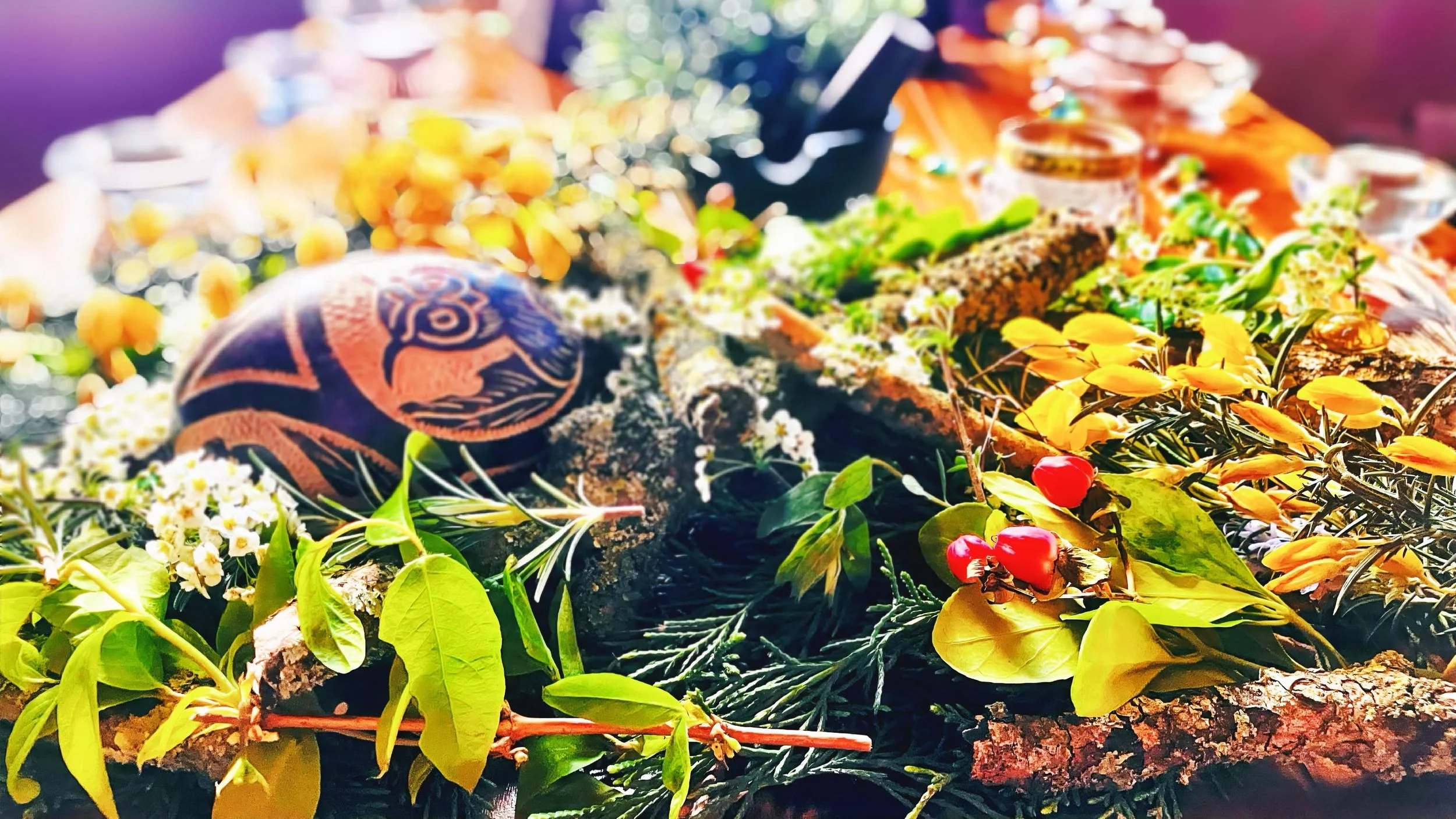
An altar, foraged from the land, built from what matters to your crossing
“Ruth’s circles are a treat for the soul!
She’s an excellent space holder who gives participants permission to join in doing what is best for them, encouraging play and deep connection.
Since joining the circles I’ve been trying to convert all my female acquaintances to the power of drumming and sound!”
Why this chronic illness grief is its own thing
The other great crossings come with a day. A diagnosis has a date. A death has a funeral. A marriage ends on paper you can hold. The grief is no smaller, but there is a line drawn, a before and an after, a moment the world agrees something happened.
Chronic illness gives you no line. It takes the old life so slowly that there is never a day, never anything marked for the woman who is gone.
You are simply expected to keep being her. To have an answer ready for why you are still not better, when you do not have one. To watch concern on a face soften into pity, and then, as the months and the years pass and you are still not well; harden into a doubt no one says aloud.
But you don't look ill.
Are you sure it isn't something else?
Maybe you should lose some weight and you’ll feel better.
Have you tried…?
Threshold Ceremonies
So you learn to say you are fine. You make it smaller, lighter, easier to be near, because the truth costs the people around you more than they can hold, and you become the one left tending their discomfort.
And one cancelled plan at a time, one unanswered invitation at a time, you begin to disappear from your own life, while everyone keeps your old place set and waits for a woman who is not coming back.
And perhaps the cruellest turn is the voice that no longer comes from outside. The doubt that was once on other people's faces, in their questions, in the things they suggested, has moved in and become your own. Now it is you who says you have no right to any of this. That you are still here, after all. That others have it worse. So you do not even let yourself grieve the life that was taken, because mourning yourself while you are still living feels like a kind of trespass.
You are allowed. A life can be grieved by the one still living it. Yours, by you.
I know this crossing from the inside. There were years my own body carried more than it could hold, when a pain that no treatment could reach took the life I had been living and gave me no say in it.
I know the loneliest part is often not the pain. It is crossing one of the biggest thresholds of your life with no one there to see you do it. No one there to witness you fully.
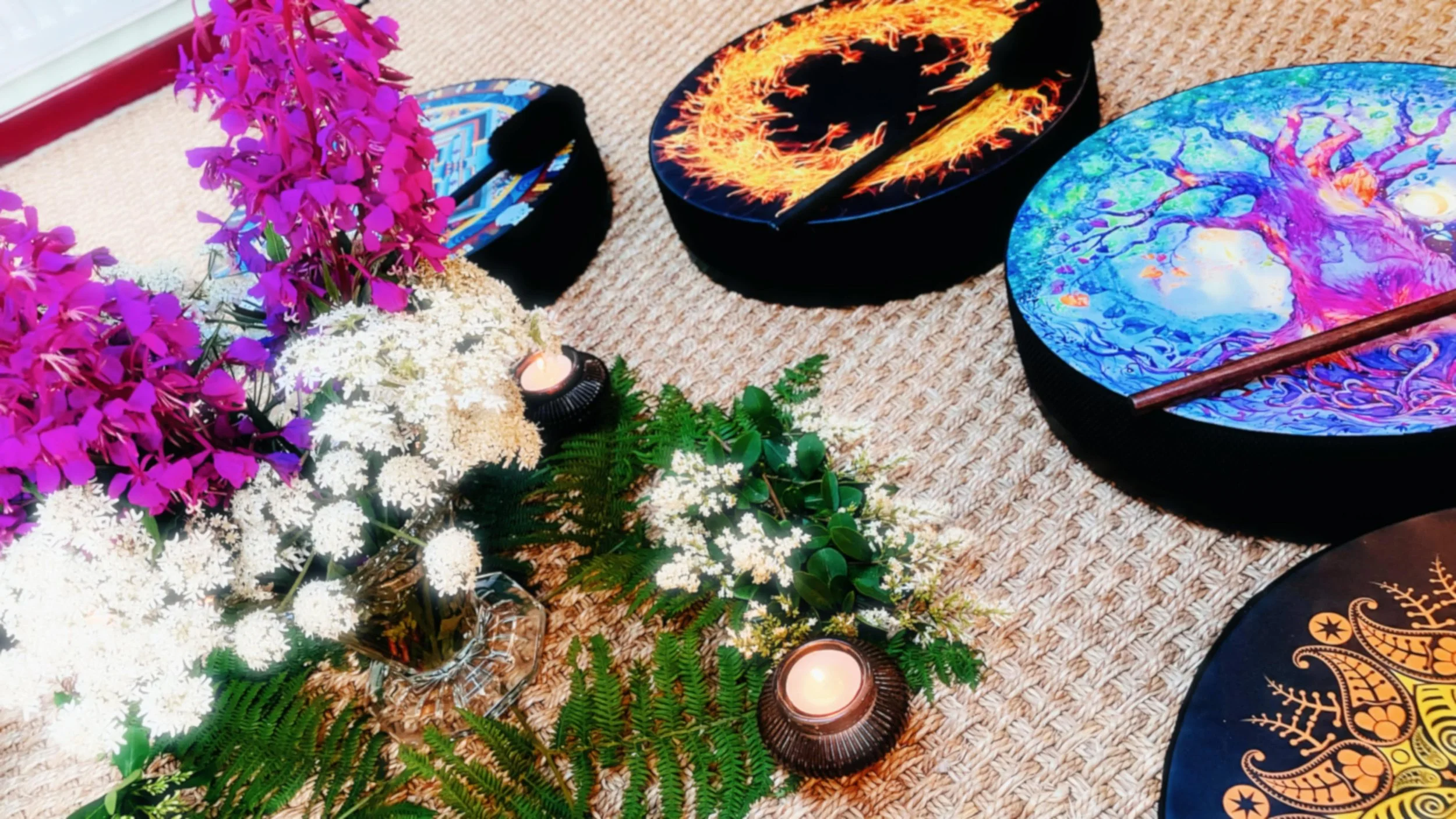
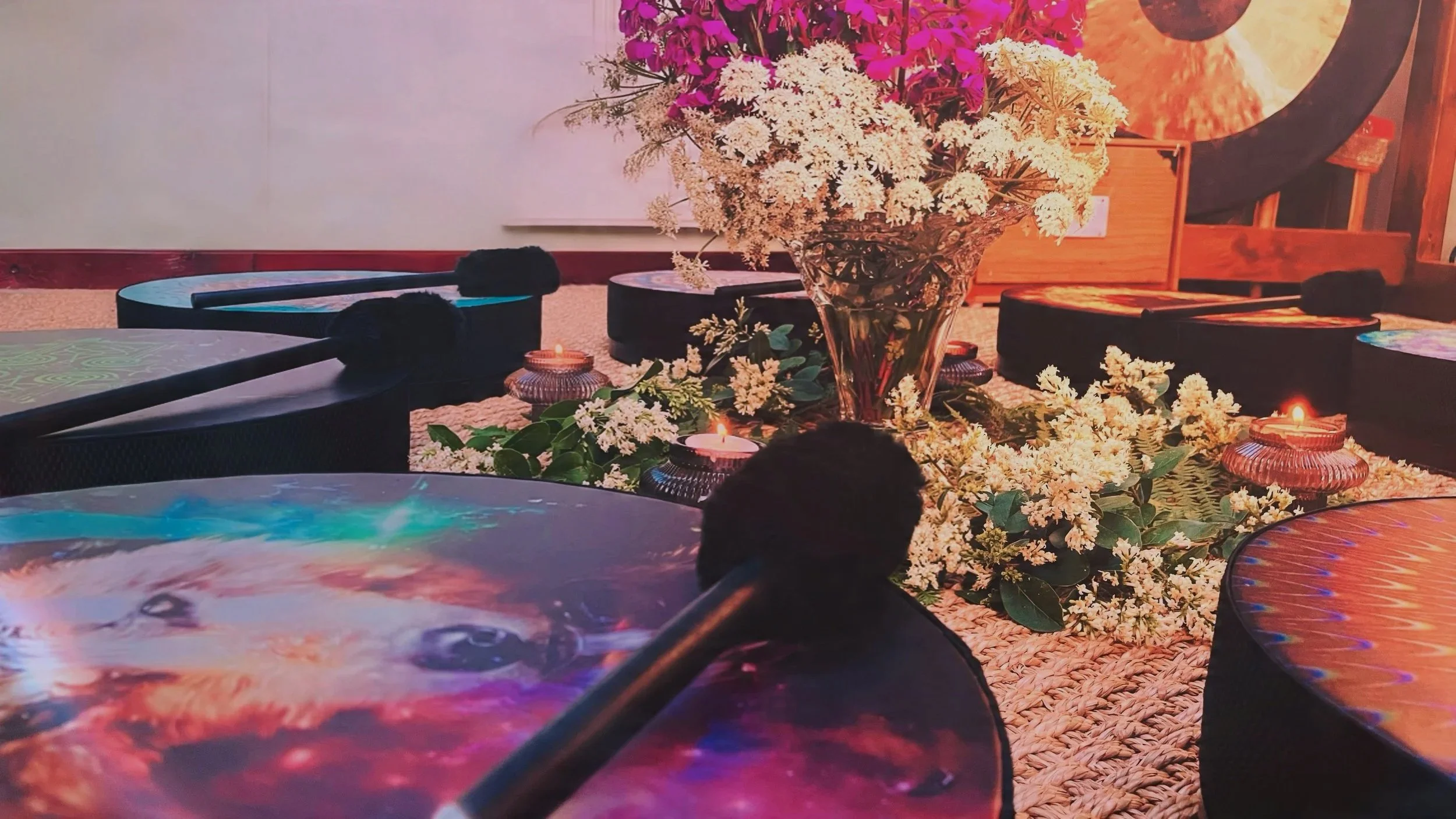
Some of the drums I would being for your ceremony for your people to drum with you in circle as you cross
What it could mean to mark it with ceremony
The crossing does not need to be over for it to be marked.
You may not get the old life back. That is the truth this work refuses to flinch from. But the woman you have become on this side of the threshold, the one who has learned what she has learned, who has lost what she has lost, who is changed, that woman can still be seen. Not the one everyone is waiting for you to be again. This one. Here.
And to be changed is not only to have lost.
Something is forged in a place like that, though no one would ever choose the forging. You learn to tell real pain from performance. You learn to sit with another person in the worst of it and not turn away, because you have been there yourself. You stop spending your life on what does not matter, because you have felt how little of it is promised. You see clearly now, in ways you could not before.
Whether it was worth it is not a question that resolves. You can hold what you have lost and what you have become at once, and feel them both fully, and they will not cancel each other out. They are not meant to. The grief does not shrink because something was gained. What was gained does not turn false because the grief is real.
And what you have become is yours. Not a gift the illness handed you, not a reward, but something you made, in a place you would never have chosen to stand. You are not asked to be grateful for it. Only to let it be seen, in the woman you are now.
Once, your people would have gathered anyway. They would have named it aloud. She is changed, and we see her, and we love the woman she is now.
There might have been an altar, built from the things that mattered. A drum to carry what words could not. A moment to set down what you have held too long, given to the fire or the water. And a moment to be welcomed in, exactly as you are now, and crowned for having crossed.
That witnessing is what was lost. It is what a threshold ceremony brings back.
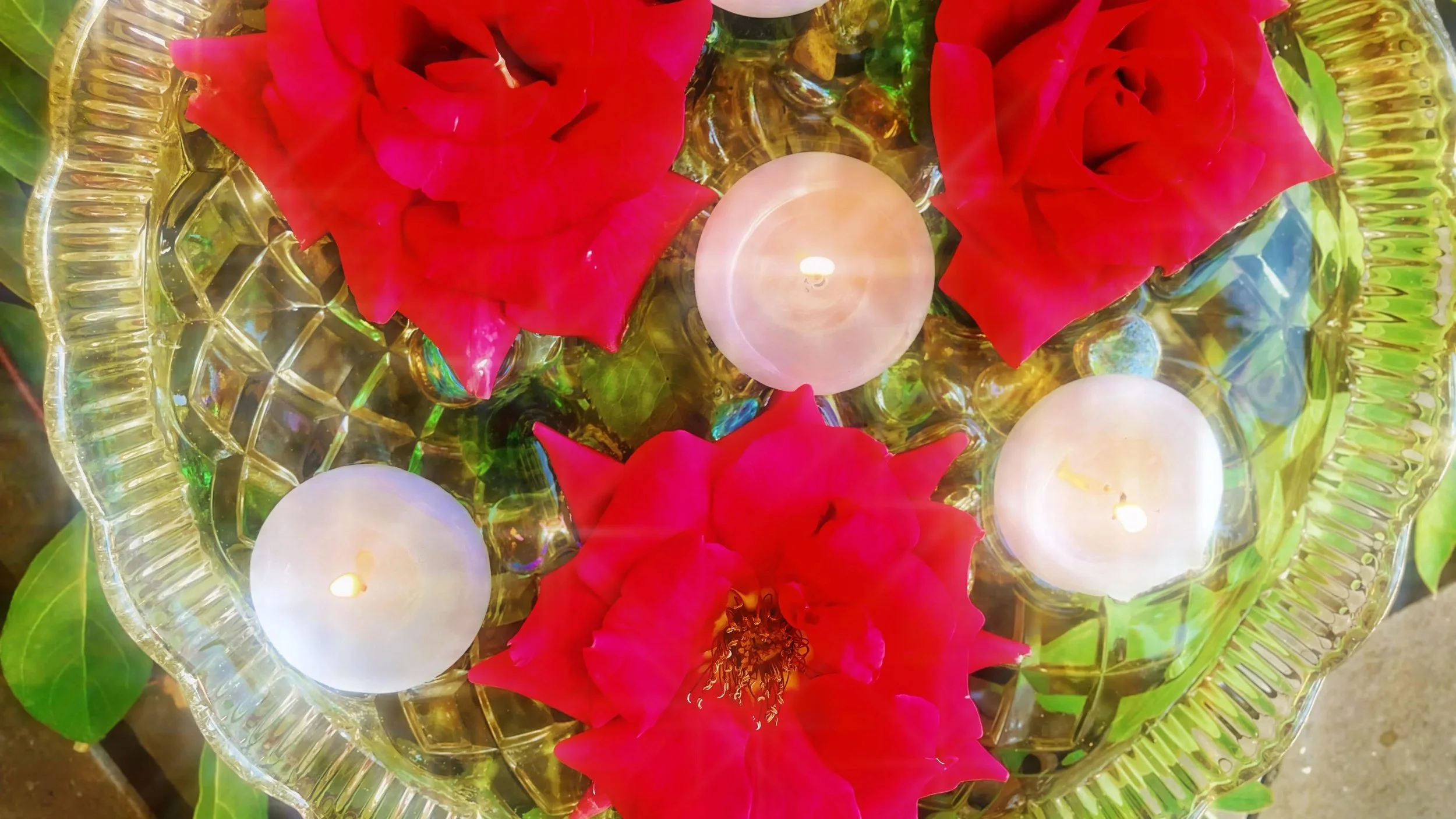
Part of an altar from a recent women’s circle
What a threshold ceremony for chronic illness can offer
-
Anthropologists have a name for what chronic illness does to a person: permanent liminality, a rite of passage left forever unfinished, stripped of the old life but never welcomed into the new one. It is not in your head.
You have been standing in a threshold no one ever helped you cross. A ceremony finishes the rite. Not to somewhere better. To here, where you actually live, with the door closed gently behind you. -
The standing down of a system that has kept watch through every flare and crash.
A body cannot order itself off that duty. But ceremony can reach it.
Studies have found that ritual measurably lowers the body's stress response, felt and physical both, and the researchers' best explanation is the oldest one. A known shape, a slow pace, nothing to decide and nothing to perform. The body reads the ritual itself as safety, and comes off the watch. -
Chronic illness often locks us in a permanent liminality where the body has crossed into sickness but no ritual or community has witnessed it Shamans across cultures have long used the drum exactly for this moment. Its steady beat is understood as the heartbeat of the earth itself; reliable, ancient, tireless.
Modern research on rhythm and the nervous system confirms what the old traditions knew: regular, predictable drumming activates the ventral vagal pathways that signal safety. Heart rate and breathing begin to synchronise with the external pulse. In group settings this co-regulation happens almost automatically; stress responses drop, the chronic “watch” system that illness keeps switched on can finally stand down.
It turns the liminal state from an endless stuck place into a passage that is witnessed, sounded, and carried by others.
-
In Ireland we keened our losses.
The bean chaointe gave grief her whole voice so that no one mourned alone, until the Church banned this practice in the 1950s.
But grief unvoiced does not leave, it just moves in, and some of its weight is in your body now.
Voiced, witnessed, given to the fire or the water, it finally has somewhere to go that is not you. -
Ritual does something to a gathering that ordinary life cannot: the anthropologists call it communitas, the moment a circle of separate people becomes one held thing.
Your people stop being worried onlookers at the edge of your illness. For one day they stand inside it with you, and that day can change how they hold you ever after. -
Psychologists call it post-traumatic growth, the real depth and clarity that can come through long adversity.
To be crowned for it, blessed and witnessed by people is how a private surviving becomes growth and wisdom that you own.